From Graph Memory to Social Emergence
A few days ago, I received a letter from a friend who is building around LLM workflows. She wrote that current AI systems are missing a layer of judgment, especially relational and strategic judgment: understanding who matters, why they matter, what opportunity exists between people, and what action should happen under a specific context. I found this very close to what I have been thinking through Ausna. The more I talk with founders, community builders, researchers, and people trying to initiate unusual projects, the more I feel that many opportunities fail before execution. They fail because the right alignment between people, interest, resource, trust, and timing never becomes visible enough to act on.
This is where I think many current AI systems reach a limit. RAG is useful because it gives LLMs access to external knowledge. GraphRAG, KAG, LightRAG, and temporal knowledge graph systems such as Zep all push this further by bringing graph structure, knowledge reasoning, and time-aware memory into retrieval. These directions are important because they show AI moving from static retrieval toward more structured and contextual memory. Still, most of them begin from documents, entities, facts, or enterprise knowledge. The problem I care about is more social-native: how can an AI system understand when people, intentions, resources, and trust are becoming aligned enough for meaningful action?
In our interviews and conversations, I kept seeing one repeated pattern. Opportunity depends on both interest and resource, but both are constantly moving. Someone may become interested in a topic because of a conversation yesterday. Someone may suddenly have access to a room, a client, a dataset, a funder, or a researcher. The best opportunity is often a changing relation. At the same time, general topics and specific instances are very different. Two people may both care about “AI and community,” but this alone does not mean they should meet. A real opportunity may depend on a specific client problem, a specific project stage, a specific trust boundary, or a specific next action.
This is the gap I currently see. Many AI systems can retrieve relevant information, and some can reason over graph-structured knowledge. But we still lack a social-native structure for emergence assistance: a way to represent what people are moving toward, what they can offer, what they are ready to receive, and what kind of action is appropriate under permissioned context.
My current attempt to think through this is Ausna Social Knowledge Graph, or ASKG. This is still an early working definition, but I want to make it concrete enough to be discussed.
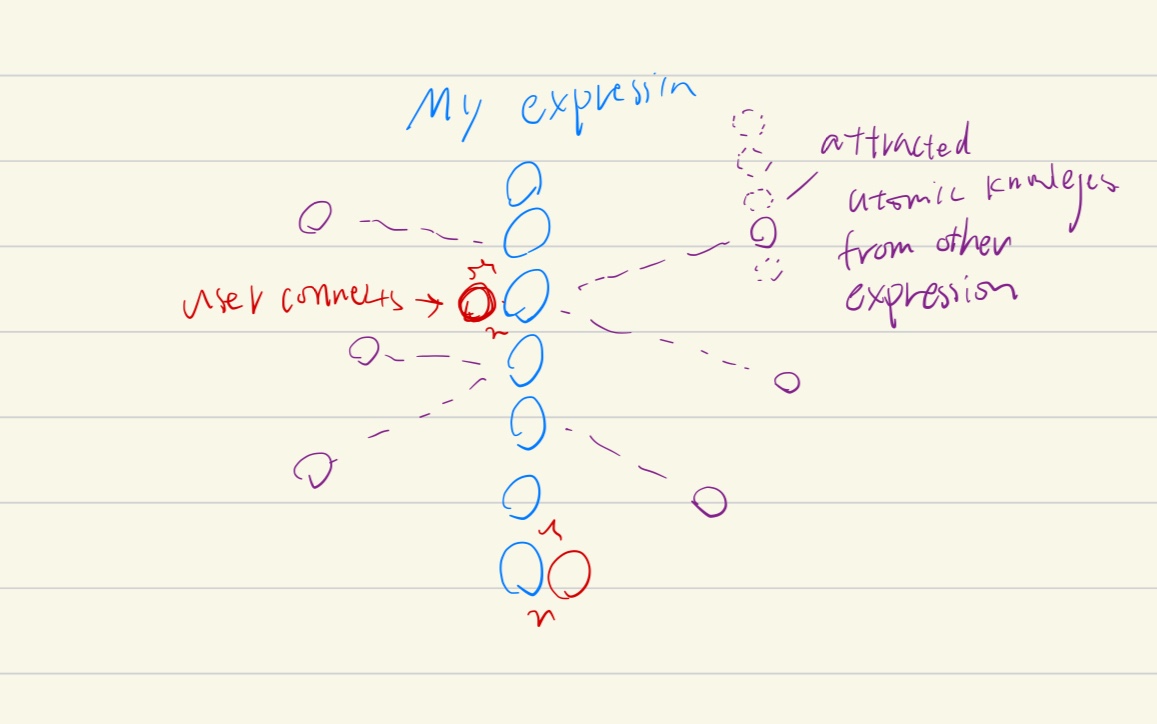
ASKG is a graph-like structure for representing social alignment. It contains two basic kinds of nodes. Specific nodes, or Ns, are concrete instances: people, projects, conversations, client needs, events, papers, prototypes, openings. General nodes, or Ng, are topics, domains, methods, values, theories, or questions. The system should connect specific nodes to general nodes, while keeping the difference clear. A topic connection should never be confused with an actionable opportunity.
The second unit is atomic knowledge, or Ak. I currently define it as:
Ak = {content, source, specific_node, general_nodes, cue, confidence, timestamp}
An atomic knowledge unit should be significant enough to support future judgment. It may come from a conversation, a paper, a profile, an event, or a project update. The “cue” matters because social memory often works through recall signals: why this piece of knowledge may become relevant later, and under what context. If someone is recommended for a collaboration, the system should be able to show the trace of why this recommendation makes sense.
The third unit is relationship. Between two specific nodes, ASKG can record:
R(Ns_i → Ns_j) = {relationship_type, short_term_strength, long_term_strength, trust_boundary, interaction_history, action_potential}
Between a specific node and a general node, ASKG can record interest and resource separately:
R(Ns → Ng) = {interest_short_term, interest_long_term, resource_short_term, resource_long_term}
This separation is important. Interest means what someone is drawn toward. Resource means what someone can actually provide. A founder may be deeply interested in AI governance, while another person may have a relevant research group, client environment, or publication channel. Opportunity appears when these two sides become compatible under the right time and trust condition.
The fourth unit is delta. ASKG should record both the current state and the movement of a relation. Long-term interest is useful, but short-term change is often where opportunity appears. Someone who has cared about community infrastructure for years may suddenly need a tool this month. Someone who usually has no available time may suddenly be looking for collaborators. For social judgment, the question is also: what is changing, and does this change create a meaningful opening?
The fifth unit is permission and action trace. Because the highest-value social signals are often sensitive, ASKG should be modular. Personal and organizational graphs can stay local or permissioned, while a shared registration or routing layer can identify possible alignment without exposing private context by default. Action trace records what the system suggested, requested, introduced, accepted, rejected, or ignored. This lets the system learn from real social outcomes, rather than only semantic similarity.
This is also why I see ASKG as related to a future agent social protocol. MCP connects agents to tools and data. A2A connects agents to other agents. But there is another layer: when should an agent recommend, introduce, invite, reveal, preserve silence, or ask permission across human networks? This layer needs primitives such as identity, consent, context boundary, trust level, intention state, resource state, and action trace.
For the technical trail, I am currently looking at RAG, GraphRAG, KAG, LightRAG, Zep, temporal knowledge graph memory, MCP, A2A, and my recent paper on MoMoE, which explores modular AI governance for online communities. The shared direction I see is a movement from static retrieval toward modular, contextual, and time-aware systems. ASKG extends this direction into social emergence: how AI can help people discover when their knowledge, resources, trust, and timing can become a real collaboration.
This is still early, and many parts need to be tested through real workflows. But I think the direction is becoming clearer. Relationship intelligence should go beyond better contact search or CRM enrichment. The deeper question is how to help meaningful alignment become visible, explainable, permissioned, and actionable. That is the layer I want to build with Ausna.